

Changemaker Spotlight: ACT's Center for Equity in Learning & the American College Application Campaign on why college is worth it
By Christina Gordon & Melissa Caperton
September 17, 2019

Christina Gordon, Senior Director at ACT's Center for Equity in Learning, and Melissa Caperton, Director of the American College Application Campaign, shared their thoughts on the #WhyApply initiative and why every student should believe they are college material.
Many people may hear “ACT” and think only of the standardized test. But ACT’s Center for Equity in Learning is about so much more. What do you want people to know about your organization?
Christina Gordon: ACT’s Center for Equity in Learning was launched in 2016 as a way for ACT to double down on our mission of education and workplace success for all people. Since then, the Center has done that work in a variety of ways, including research and thought leadership; partnerships and outreach; and the development of projects and initiatives. We are able to leverage ACT’s research in ways that examine key issues in equity, like the digital divide or rural student success, and make recommendations for improvements. Working together with partners who are also working in the equity landscape, the Center is better able to cast a wide, but deliberate net to effect change in areas like social and emotional learning, college and career navigation, and innovation. Our work with ACAC is another way to ensure we are making change happen where it’s most needed.
Tell us about the partnership between ACT’s Center for Equity in Learning and the American College Application Campaign (ACAC), the #WhyApply initiative, and why these efforts are especially important in today’s higher education landscape.
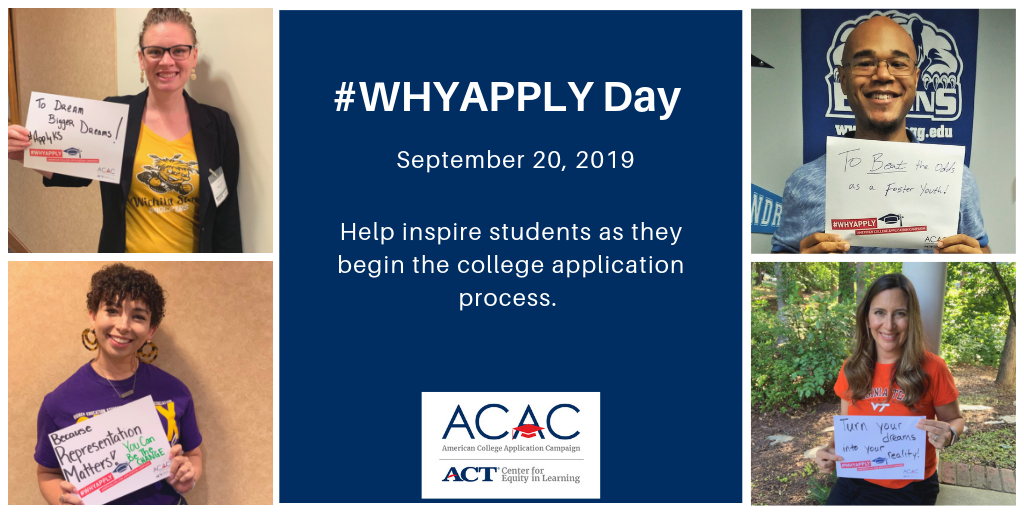
Melissa Caperton: After a long-standing partnership, the American College Application Campaign became part of ACT’s Center for Equity in Learning in January 2019. We are so excited to celebrate our first #WhyApply Day as an ACT’s Center for Equity in Learning initiative this Friday, September 20. #WhyApply Day is intended to kick-off the college application season and to encourage and inspire all students to pursue education beyond high school. At a time when students and their families may question the value of a college education, we want to put a spotlight on the fact that education beyond high schools remains the surest way to achieve higher lifetime wages, job security, and economic mobility.
ACAC programs take place in all 50 states and Washington, DC. How does ACAC support state campaigns and how can schools and districts get involved with these campaigns at the local level?
MC: The ACAC team provides technical assistance to states and high schools through an annual ACAC National Convening for our state coordinators and state-level training of high schools hosting college application events. We also provide a variety of free resources that states and high schools can use to support the successful implementation of college application events. Finally, we aim to continuously connect the network of state and school partners leading this work through webinars and by elevating via social media the impactful work our partners are doing. To register your school as a college application event site, you can contact your ACAC State Coordinator.
What barriers might exist that might prevent a student from successfully applying to college?
MC: A vast majority of students in middle school will tell you that they plan to go to college. But along the way, we begin to lose some students including during senior year when many students do not apply, apply very late in their senior year, or do not apply to colleges that align with their goals and talents. And this disproportionally affects minority students, students from low-income backgrounds, and first generation students. Students may be unsure of the process, they may not have someone at home who knows how to help them research colleges or complete a college application, they may think college is out of reach financially and be unaware of the FAFSA or how to complete it. Students may question whether they are “college material” and they may not have anyone talking to them about education beyond high school and what their postsecondary options are. ACAC aims to change that narrative by providing a network of support to students as they prepare for and complete the college application process.
There is a pathway out there for everyone! I want students to know that there is no one “right” way to success after high school.
What message do you hope to communicate to students about the importance of applying to college?
MC: First, I hope all students hear and believe that they are college material – that there is a postsecondary pathway for each student to pursue their goals and dreams, be it a certificate, a two-year degree, or four-year degree. And, second, I want them to know they have a network of support to help them navigate the process, to answer questions, and to celebrate the accomplishment of this milestone.
CG: There is a pathway out there for everyone! I want students to know that there is no one “right” way to success after high school. The best first step is to start asking questions of people in your life: family members, teachers, school counselors, friends, coworkers. People who have been through it (or want to go through it too) can be a great resource and network. The future is yours – you just have to start!
Many parents of first-generation students often struggle to support their students through the college exploration and application process. In what ways can parents get involved in the college process?
A: We encourage families to partner with their student in this process by attending family information nights provided by the school, attending college fairs, and by taking tours – in-person or virtual! – of the schools their student is exploring. The more information you can gather, the more confident you’ll feel in the decisions you make. ACAC has a variety of student resources to support the college exploration and application process. It is important to consider match and fit when identifying the colleges a student wants to apply to. For example, a student should consider how their academics align with the admissions requirements, whether the institution offers their desired major, and whether the college offers the setting and resources the student needs to feel successful. We also encourage families to have honest conversations with students early in the college-going process about finances and what, if anything, the family can contribute. While it shouldn’t be the only factor in deciding which postsecondary pathway to pursue, finances are an important factor to consider. This can be a scary and overwhelming time for students and their families so ask questions – to the school counselor, recent graduates, higher education representatives, and others you know who have pursued education beyond high school – to get the support you need to navigate the process. Finally, we encourage families to serve as a volunteer at their school’s college application event.
School counselors are provide critical support to students and their families. How can the higher education community most effectively provide them with support?
A: We love college application events because it’s such a fun and meaningful way for K-12 and higher education to partner. Leading up to college application events, the higher education community can partner with school counselors to participate in family information nights and at college fairs. In addition, if their institution can send giveaways (pennants, t-shirts, and other branded college gear) to participating schools, these materials can help build awareness and excitement for the upcoming college application event. During college application events, we encourage the higher education community to serve as volunteers. And while they are welcome to share information about the institution at which they work, we ask that volunteers support all students in applying to college, regardless of where they are submitting applications. Finally, engaging with and celebrating students and participating high schools on social media during college application events is a great way to support these efforts.
Looking back on the #WhyApply campaign over the years, is there a #WhyApply message that has stuck with each of you? Why did it resonate with you and others?
MC: There have been so many wonderful #WhyApply messages over the years, it is hard to pick just one. But, I think the one that has really resonated with me is: “You can’t go if you don’t apply.” Completing a college application is a critical step in the college-going process. Encouraging and supporting students through this process helps open doors that would remain closed without taking this step.
CG: To me, it’s the message of taking that first step to apply. It’s not too late to explore the possibilities, to see what schools have to offer, and to find the path that’s right for you. Get started – there are so many who are ready and willing to help.
Why do you think college is worth it?
MC: Because every student’s dreams are worth pursuing and college is the surest way to turn those dreams into reality. (MC)
CG: College is transformative in more ways than one. It’s not just the education you get in the classroom, but the people you meet, the experiences you have, the conversations that develop. The college experience is one that opens your mind and develops a mindset of lifelong learning.
To learn more about how to get involved in the #WhyApply campaign, visit the American College Application Campaign website.